
Locked Out? Emergency Locksmith Support Available
Get Answers & Flat Prices
Industrial properties in Scarborough face a level of wear, force, and traffic that simply doesn’t exist in retail environments. A distribution hub near Progress Avenue, an auto body shop on Kennedy Road, or a manufacturing floor in Wexford operates with a constant rhythm of trucks backing in, shift workers coming and going, and equipment rolling through heavy fire-rated doors all day. While retail stores focus on customer access, presentation, and convenience, industrial sites focus on preventing unauthorized entry, protecting equipment, and making sure every exterior and interior door keeps working even with daily punishment.
A typical retail store relies on lighter commercial hardware because its doors aren’t slammed by wind, forklifts don’t hit the frames, and staff aren’t moving crates or machinery through every doorway. Industrial properties have a completely different reality. Doors are bigger, heavier, and often reinforced steel. Frames are constantly stressed. And every lock must survive repeated cycles in temperatures that can shift drastically between indoor and outdoor areas. Retail simply doesn’t deal with that environment.
In Scarborough’s industrial zones, a standard lock that works fine on a Danforth storefront wouldn’t last a month inside a truck loading area. This is why industrial spaces depend on stronger lock bodies, thicker strike plates, deeper backsets, and mortise cases that can handle weight and impact.
Factories and manufacturing plants typically use high-grade mortise locks because they offer internal strength you won’t find in regular cylindrical levers. Auto shops often prefer heavy-duty lever sets with clutch mechanisms, so staff can pull, push, and use the door hard without breaking the handle. Distribution centers rely on reinforced steel hardware because their doors are often exterior fire-rated or built into steel frames that shift slightly under temperature or vibration.
Brands commonly installed across Scarborough’s industrial sector include Sargent, Medeco, Yale Commercial, Corbin Russwin, Dormakaba, and Schlage ND/AL series, all built to withstand constant use far beyond what retail shops ever demand. When we install these locks, we aren’t just thinking about today — we’re thinking about ten years of daily operation under hard, real conditions.
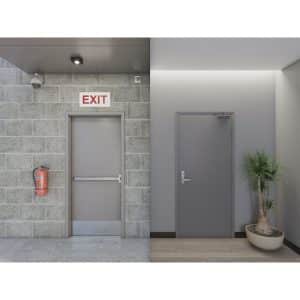
One major difference between industrial and retail properties is how frequently industrial doors are used. A warehouse door may open and close hundreds of times a day. A shipping bay door can operate almost nonstop during delivery hours. Retail properties may only have steady activity during open hours, whereas industrial buildings work morning, evening, and sometimes overnight.
The constant motion affects door alignment, tension, and hardware fatigue. This is why industrial sites use high-tension door closers that control heavy doors without slamming or bouncing. A standard Grade 2 closer simply can’t manage a steel commercial door in a Scarborough winter when wind pressure or temperature shifts can make the door feel twice as heavy.
Industrial spaces also rely on reinforced hinges, continuous gear hinges, and steel frames that keep everything stable even when carts or machinery hit the door or frame accidentally. When service teams install or repair locks in these environments, the entire opening must be evaluated — the frame, the hinges, the closer, and the lock — because every part affects the others.
Most retail businesses have maybe two or three points of entry: front door, back door, and sometimes a side door. Industrial buildings are a completely different world. They may have eight, twelve, or even twenty access points, depending on their layout. Some doors lead to electrical rooms. Some lead to chemical storage. Some open into staff locker rooms. Others connect different production zones where safety protocols limit who can enter.
Every one of these access points requires different hardware. Some doors demand push-pad panic bars for emergency exits. Others require reinforced deadbolts with restricted keys to protect inventory. And some require a hybrid setup using electronic access controls for staff while maintaining a mechanical backup in case of system failure.
Scarborough’s industrial buildings often mix older structures with new expansions, meaning no two doorways are the same. When we upgrade security in these environments, it’s never a one-size solution. Each opening is evaluated individually and fitted with hardware that suits its job, not just its appearance.
Industrial sites rely heavily on mortise locks because the lock body is encased inside the door, making it stronger, more resistant to pull attacks, and much better suited for repeated heavy use. Retail spaces generally get by with cylindrical levers because they don’t expect the same force or foot traffic.
Mortise locks also offer better internal mechanisms, allowing them to handle weight, vibration, and the occasional accidental hit from equipment or large objects. They integrate well with Scarborough-grade reinforced steel doors that many factories and shops already have.
For interior industrial doors — especially equipment rooms, mechanical spaces, and staff-only areas — heavy-duty lever sets with Grade 1 certification are often the right choice. These levers allow quick operation while resisting torque, twisting force, and impact.
In industrial facilities across Scarborough, the door closer is often the unsung hero. Without a strong closer, even the toughest lock will fail because the door won’t sit perfectly aligned. Industrial sites frequently battle air pressure differences between temperature-controlled areas, meaning the closer must be strong enough to pull the door closed every time.
This is where brands like LCN, Dormakaba, and Norton excel. Their commercial and industrial closers are engineered to handle weight, pressure, and long-term cycle counts. If a door doesn’t latch consistently in an industrial building, the issue is rarely the lock first — it’s the closer, the hinges, or the frame alignment.

In retail, doors get used gently. Industrial doors get hit, pulled, kicked, or dragged by accident every day. Workers might carry tools or heavy material and push the door with their shoulder instead of using the handle. Wind pushes exterior doors hard. Forklifts bump frames. All of this means industrial hardware must survive real-world abuse and still work flawlessly.
This is why commercial steel doors with reinforced cores are paired with Grade 1 locks and heavy-duty strikes. The combination ensures that repeated impact doesn’t knock the door out of alignment or weaken the locking mechanism.
One of the biggest differences between industrial and retail security is the need for master-key systems. A Scarborough factory, school, large office building, or multi-unit commercial complex may have dozens of locks, each requiring controlled access. A retail store rarely needs this level of structure.
A well-built master key system lets supervisors, maintenance teams, managers, and owners access appropriate areas without compromising security. It also prevents staff from entering restricted rooms without authorization. Systems from Medeco, Mul-T-Lock, Sargent, and CX5 are especially popular due to their restricted keyways and tamper-resistant internal construction.
A properly designed master key system saves time, improves safety, and eliminates the chaos of carrying multiple keys. For large facilities across Scarborough, it’s one of the smartest upgrades they can make.
Scarborough is unique because it combines industrial clusters, older plaza-style retail spaces, and newly redeveloped commercial hubs. This mixture means locksmiths working here must understand both old construction and new building standards.
Some buildings near Ellesmere may still have original steel doors from the 1980s that need retrofitting. Others in the McCowan business district may have modern electronic access systems. Industrial locksmith work here isn’t about replacing hardware — it’s about matching the right equipment to the right building while respecting budget and long-term performance.